All Insights
The Enterprise Evaluation Framework for OpenClaw

By Wenxi Huang
What is OpenClaw and Why did 160,000 Developers Drop What They're Doing?
OpenClaw is an open-source, autonomous AI agent that connects large language models to your computer, your accounts, and your tools. It reads your email, writes code, manages files, browses the web, and executes shell commands, all without asking for permission at every step.
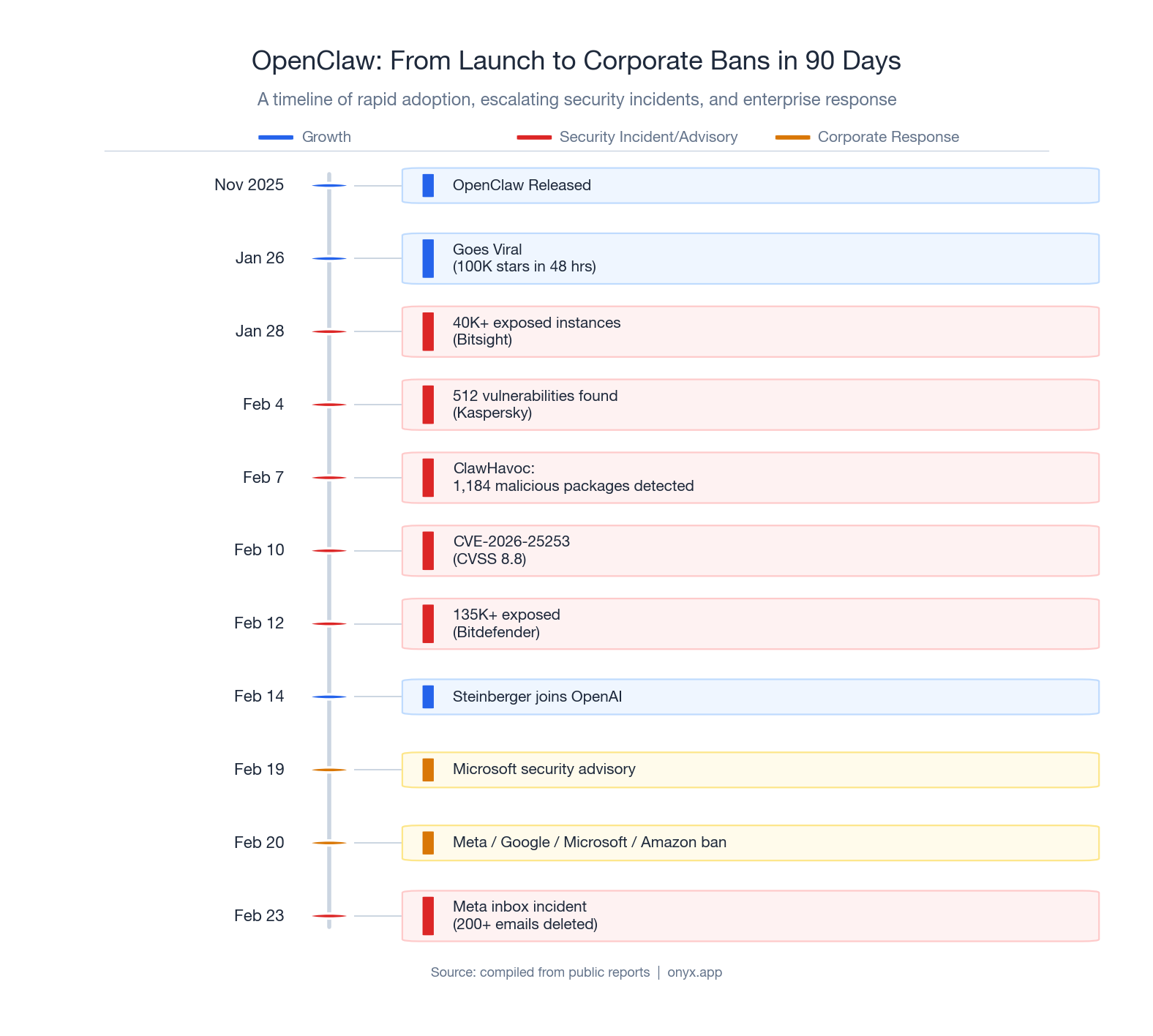
Created by Austrian developer Peter Steinberger and released in November 2025, OpenClaw attracted over 150,000 GitHub stars and 2 million visitors in a single week after going viral in January 2026. By mid-February, Steinberger had joined OpenAI to lead their "next generation of personal agents."
The security numbers are a bit less impressive.
Within the first 24 hours of scanning, Bitsight's STRIKE team identified over 40,000 exposed OpenClaw instances. Bitdefender later counted 135,000+ publicly accessible instances, many over unencrypted HTTP. SecurityScorecard found that 63% of observed deployments were vulnerable, with 12,812 instances exploitable via remote code execution.
A security audit identified 512 vulnerabilities, 8 classified as critical. A one-click RCE vulnerability (CVE-2026-25253) with a CVSS score of 8.8 affects versions before 2026.1.29. And a supply chain campaign called ClawHavoc poisoned the skill marketplace with over 1,184 malicious packages.
Meanwhile, Token found that 1 in 5 of their customers had deployed OpenClaw without IT approval. Meta, Google, Microsoft, and Amazon have all banned it from corporate hardware.
Every major security vendor has published an advisory. Not one has published a structured evaluation framework.
This article introduces the CLAW-10 Enterprise Readiness Matrix: a vendor-neutral, 10-dimension scoring system that any security team can use to evaluate OpenClaw (or any autonomous AI agent) against enterprise requirements.
What Is Onyx?
Onyx is an open-source enterprise AI platform that gives organizations a governed alternative to unmanaged agent tools. In the context of OpenClaw evaluation, Onyx is relevant because it combines AI assistants, enterprise search, custom agents, permission-aware data access, auditability, and self-hosted deployment in a platform IT and security teams can inspect.
The goal is not to ban experimentation. The goal is to route high-risk agent demand into an approved system with clearer data boundaries, model controls, and administrative oversight.
The CLAW-10 Enterprise Readiness Matrix
Most security advisories on OpenClaw can be summarized as "don't touch it." Although autonomous AI agents might not be ready for enterprise deployments today, security teams should have the tools to keep a pulse on the evolving risk posture of these agents
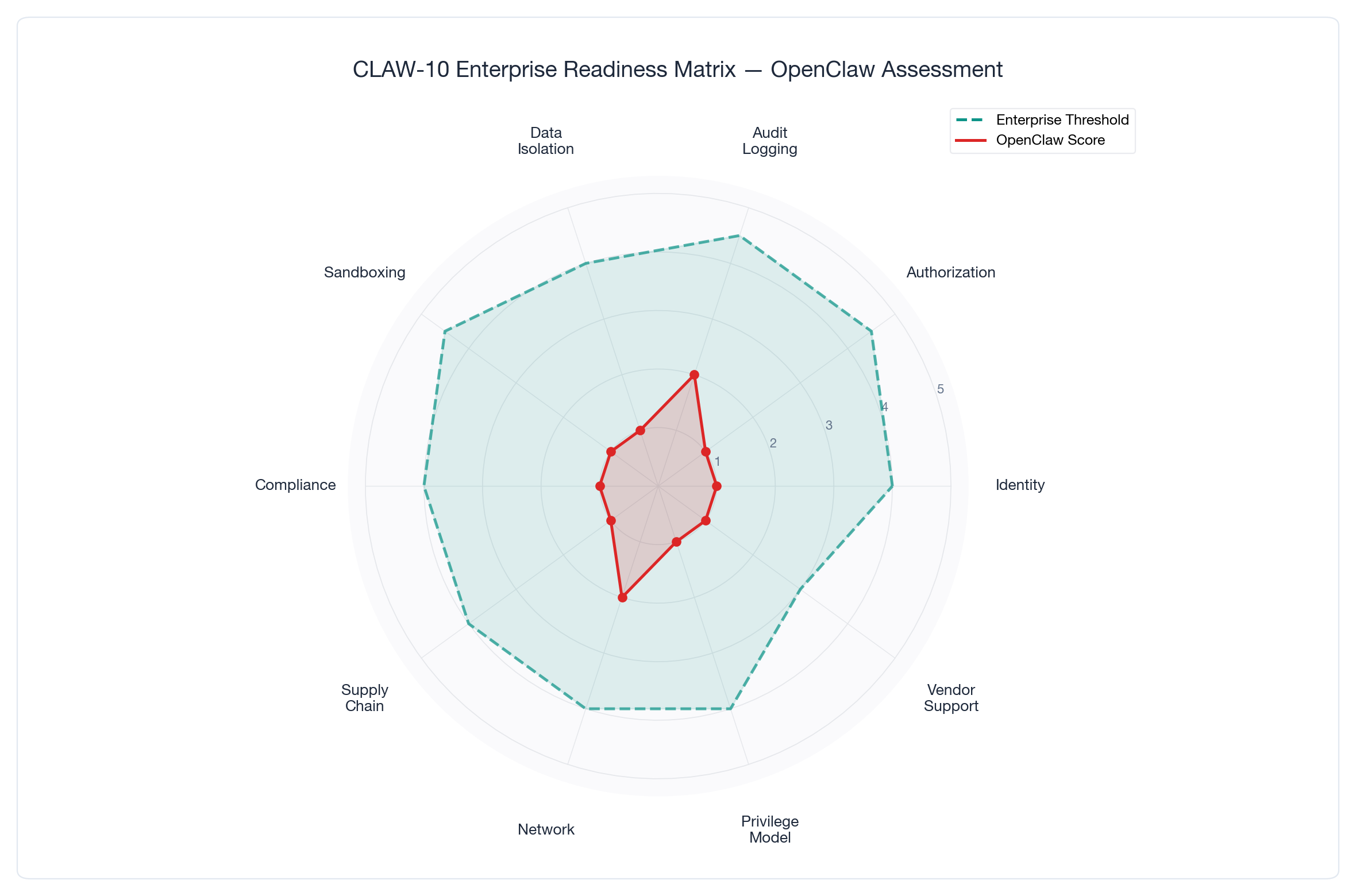
The CLAW-10 Matrix evaluates autonomous AI agents across 10 dimensions that matter to enterprise buyers. Each dimension receives a score from 1 (missing or minimal) to 5 (best-in-class), based on publicly documented evidence. We define a score of 4 as the minimum enterprise-ready threshold.
Here's how OpenClaw scores today.
Scoring Summary
| # | Dimension | OpenClaw Score | Enterprise Threshold | Verdict |
|---|---|---|---|---|
| 1 | Identity & Authentication | 1 / 5 | 4 | Critical gap |
| 2 | Authorization & Access Control | 1 / 5 | 4.5 | Critical gap |
| 3 | Audit Logging & Observability | 2 / 5 | 4.5 | Major gap |
| 4 | Data Isolation & Residency | 1 / 5 | 4 | Critical gap |
| 5 | Execution Sandboxing | 1 / 5 | 4.5 | Critical gap |
| 6 | Compliance Certifications | 1 / 5 | 4 | Critical gap |
| 7 | Supply Chain Security | 1 / 5 | 4 | Critical gap |
| 8 | Network Exposure & Attack Surface | 2 / 5 | 4 | Major gap |
| 9 | Privilege Model | 1 / 5 | 4 | Critical gap |
| 10 | Vendor Support & SLAs | 1 / 5 | 3 | Major gap |
| Composite Score | 1.2 / 5 | 4.0 | Not enterprise-ready |
Dimension 1: Identity & Authentication (Score: 1/5)
OpenClaw has no built-in SSO, SAML, or OIDC integration. There's no multi-factor authentication. Users authenticate with personal credentials that the agent then inherits directly.
Microsoft's security team explicitly states OpenClaw requires "dedicated non-privileged credentials" for evaluation, implicitly acknowledging that the default credential model is inadequate.
What enterprise-grade looks like: SSO integration via OIDC/SAML, MFA enforcement, session management with token rotation, and identity federation with existing directory services.
Dimension 2: Authorization & Access Control (Score: 1/5)
There's no role-based access control (RBAC). No attribute-based access control (ABAC). No permission boundaries whatsoever.
When you grant OpenClaw your credentials, it inherits all your permissions with none of your judgment. CrowdStrike describes the result: "A compromised agent can use its legitimate tool access to move laterally across systems; shell access becomes the attacker's shell, API keys become the attacker's API keys."
What enterprise-grade looks like: RBAC with least-privilege defaults, per-task permission scoping, human-in-the-loop approval for sensitive operations, and permission inheritance controls.
Dimension 3: Audit Logging & Observability (Score: 2/5)
OpenClaw provides basic conversation logging, but it falls short of enterprise audit requirements. There's no centralized, tamper-evident audit trail. No integration with SIEM or SOAR platforms. No structured event logging that maps to compliance frameworks.
The score of 2 reflects that some activity is recorded locally, but the logs lack the immutability, completeness, and exportability that compliance teams require.
What enterprise-grade looks like: Structured, tamper-evident audit logs with SIEM integration, real-time alerting on anomalous agent behavior, and compliance-mapped event taxonomy.
Dimension 4: Data Isolation & Residency (Score: 1/5)
OpenClaw stores API keys and session data in plaintext files. Bitdefender documented active exploitation campaigns targeting ~/.clawdbot/.env containing plain-text API keys for OpenAI, Anthropic, and AWS.
There's no tenant isolation, no data residency controls, and no encryption at rest for sensitive configuration. Kaspersky confirmed thousands of exposed control panels leaking API keys and private messages.
What enterprise-grade looks like: Encrypted credential storage, tenant-level data isolation, configurable data residency, and secrets management integration (HashiCorp Vault, AWS Secrets Manager).
Dimension 5: Execution Sandboxing (Score: 1/5)
OpenClaw executes with the full privileges of the host user. There's no container isolation, no syscall filtering, no filesystem restrictions.
Microsoft calls it "untrusted code execution with persistent credentials" and recommends deployment only in a "fully isolated VM." Sophos concludes it "can only be run 'safely' in a disposable sandbox with no access to sensitive data".
What enterprise-grade looks like: Containerized or VM-isolated execution, syscall filtering (seccomp/AppArmor), ephemeral runtime environments, and resource quotas.
Dimension 6: Compliance Certifications (Score: 1/5)
OpenClaw holds no SOC 2, HIPAA, GDPR, ISO 27001, or FedRAMP certifications. There's no compliance documentation, no data processing agreements, and no published security practices.
For regulated industries (finance, healthcare, government), this is a non-starter without significant compensating controls.
What enterprise-grade looks like: SOC 2 Type II certification at minimum, with industry-specific certifications (HIPAA BAA, GDPR DPA) and published security whitepapers.
Dimension 7: Supply Chain Security (Score: 1/5)
The ClawHavoc campaign revealed the depth of the problem. The skill marketplace required only a GitHub account at least one week old: no static analysis, no code review, no signing. A single author published 677 malicious packages.
Cisco's Skill Scanner found 9 security findings including 2 critical and 5 high severity. One skill silently executed curl commands sending data to an external server with zero user awareness.
What enterprise-grade looks like: Signed and verified extensions, automated security scanning, curated and audited marketplace, and supply chain attestation (SLSA/SBOM).
Dimension 8: Network Exposure & Attack Surface (Score: 2/5)
OpenClaw listens on port 18789 by default. While it can be configured for localhost-only binding, the default configuration has led to massive exposure. The CVE-2026-25253 vulnerability works even on localhost-bound instances by pivoting through the victim's browser.
The score of 2 reflects that network binding is configurable, but the defaults are dangerous and the attack surface through browser-based pivots remains.
What enterprise-grade looks like: Secure defaults (localhost-only with authentication), TLS enforcement, API gateway integration, and network segmentation support.
Dimension 9: Privilege Model (Score: 1/5)
OpenClaw operates on an ambient authority model. The agent inherits the full permissions of the user who launched it. There's no concept of least privilege, scoped tokens, or task-specific authorization.
Sophos calls this the "lethal trifecta": access to private data, ability to communicate externally, and ability to process untrusted content. Combined with an LLM that can't distinguish between user instructions and injected prompts, this model is architecturally incompatible with enterprise security requirements.
What enterprise-grade looks like: Capability-based security model, scoped tokens per task, principle of least privilege enforced at the platform level, and cryptographic permission boundaries.
Dimension 10: Vendor Support & SLAs (Score: 1/5)
OpenClaw is a community project. The original creator has left to join OpenAI. There's no commercial entity providing support, no SLAs, no incident response team, and no guaranteed maintenance schedule.
For enterprise deployments, vendor accountability is non-negotiable. When a security incident occurs at 2 AM, you need someone to call.
What enterprise-grade looks like: Dedicated support with SLAs, published incident response procedures, regular security updates with defined cadence, and a commercial entity that can sign contracts.
How to Use the CLAW-10 Matrix
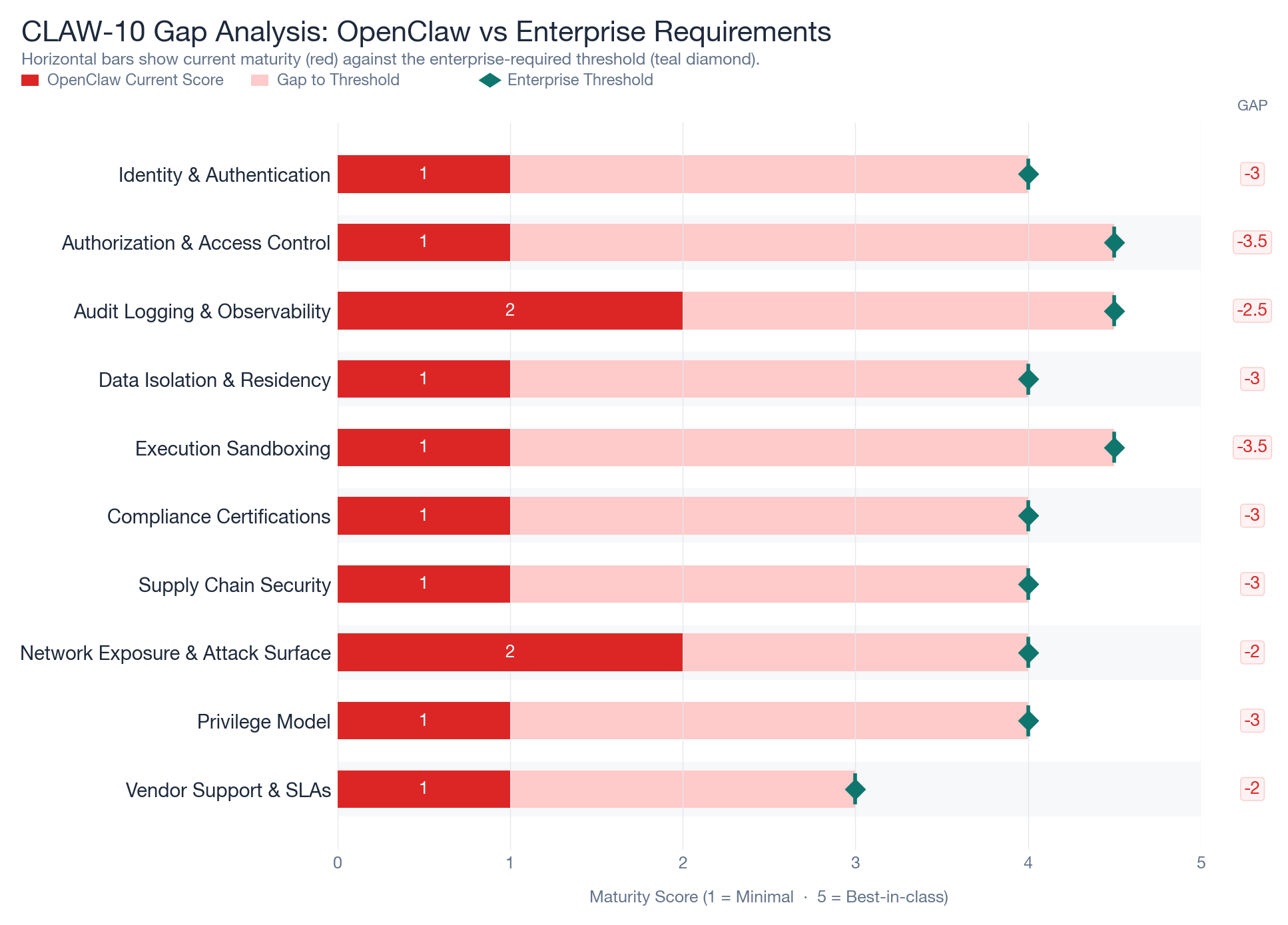
The CLAW-10 Matrix isn't a pass/fail test. It's a structured conversation tool for security teams evaluating any autonomous AI agent.
Step 1: Weight the dimensions: Not every dimension carries equal weight for every organization. A healthcare company will weight Compliance Certifications and Data Isolation higher. A startup may accept more risk on Vendor Support if the open-source community is strong.
Step 2: Set your thresholds: Define the minimum acceptable score for each dimension. Most enterprises will require a 4 or higher on Identity, Authorization, and Execution Sandboxing before approving any deployment.
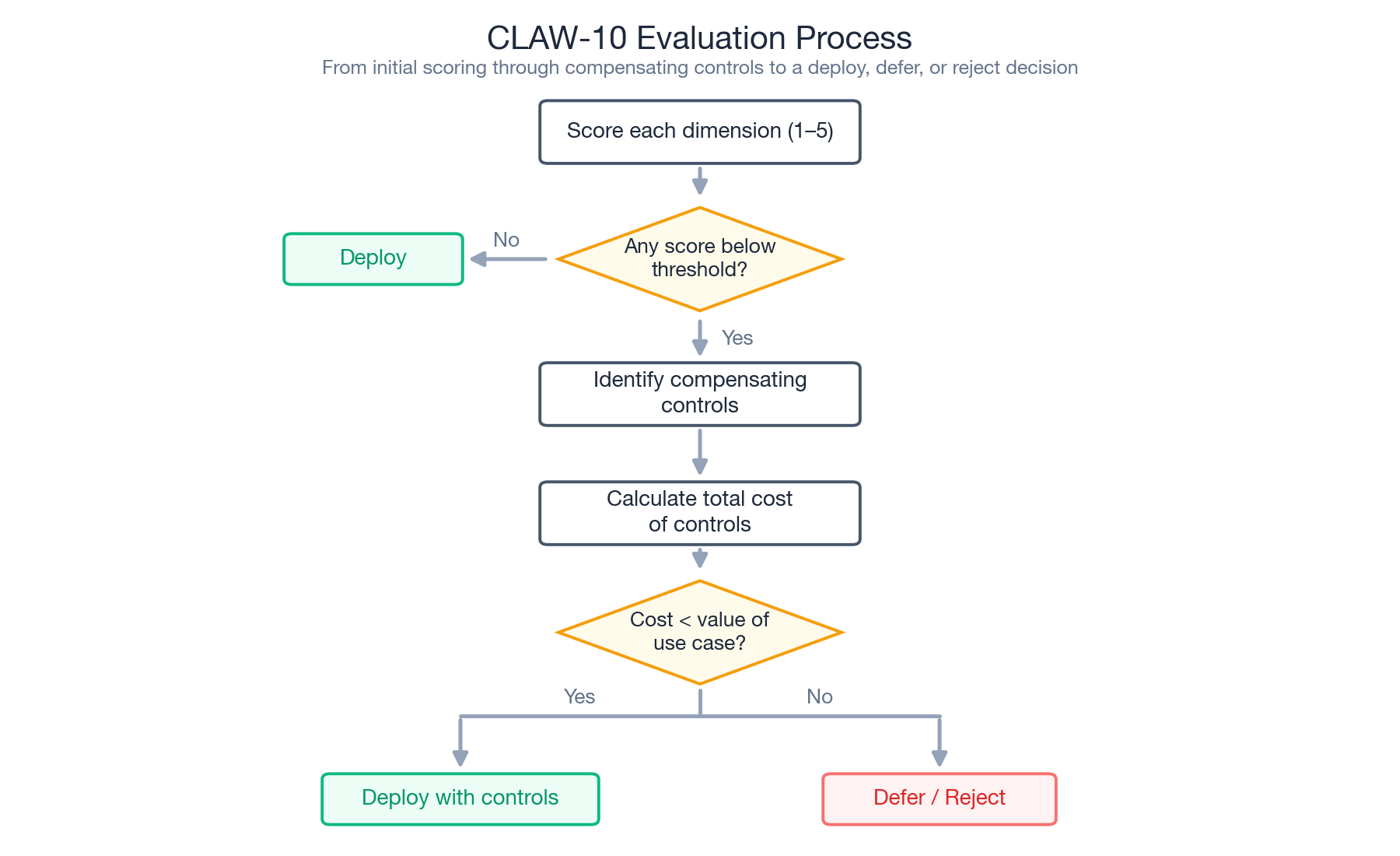
Step 3: Identify compensating controls: A low score doesn't automatically mean "reject." It means "what compensating controls would bring this dimension to an acceptable level, and what does that cost?" Microsoft's guidance to deploy in a fully isolated VM with dedicated credentials is a compensating control, but it adds operational complexity and cost.
Step 4: Calculate total cost of readiness: Sum the compensating controls needed to close every gap. If the total cost exceeds the value of the use case, the evaluation is complete.
For OpenClaw specifically, the composite score of 1.2 out of 5 means significant compensating controls across nearly every dimension. Unless your organization has deep security engineering capacity and a specific use case that justifies the investment, OpenClaw isn't enterprise-ready in its current form.
Recommended Evaluation Setup
| Evaluation layer | What to require | Why |
|---|---|---|
| Identity | SSO, SCIM, role mapping, and named owners | Prevents anonymous or unmanaged agent access |
| Data access | Source permissions, data classification, and retrieval boundaries | Limits oversharing from internal systems |
| Execution | Sandboxing, action allowlists, and approval gates | Reduces blast radius from agent tool use |
| Observability | Audit logs, prompt/action history, and anomaly review | Gives security teams evidence after incidents |
| Alternative path | Governed platform such as Onyx for approved AI work | Channels demand away from shadow deployments |
The framework should evaluate both the risky tool and the substitute you offer employees. A weak substitute makes policy harder to enforce.
What Enterprise-Grade AI Agents Actually Require
The CLAW-10 gaps aren't unique to OpenClaw. They reflect a broader industry challenge: most autonomous AI agent frameworks were built for individual developers, not enterprise security teams.
The architectural pattern that closes these gaps is well understood:
- Sandboxed execution that isolates agent actions from the host environment
- Role-based access control that scopes agent permissions to the minimum required for each task
- Immutable audit logging that records every action for compliance and incident response
- Data isolation that respects existing access controls and residency requirements
- Verified supply chains with signed extensions and automated security scanning
These aren't aspirational features. They're baseline requirements for any tool that accesses enterprise data and executes actions autonomously.
Onyx, for example, is building sandboxed AI agents with these enterprise controls: SOC 2 Type II certified, self-hostable, with SSO/RBAC and permission-aware data access built in from the start.
If you're evaluating an AI agent platform, start with the CLAW-10 dimensions and require a score of 4 or higher on Identity, Authorization, and Execution Sandboxing before any deployment reaches production data.
This article is the first of a 4-part series on enterprise AI agent security. It was last updated on May 7, 2026.
Frequently Asked Questions
What is the main enterprise risk with OpenClaw-style tools?
The main risk is unmanaged autonomy. If an agent can access sensitive data, use broad credentials, execute actions, or operate outside audit logging, security teams cannot reliably control or investigate its behavior.
Should enterprises ban autonomous AI agents?
A temporary block may be appropriate for high-risk tools, but a ban-only approach usually fails over time. Enterprises also need an approved alternative for legitimate AI work.
What should an enterprise agent evaluation include?
Evaluate identity, authorization, data isolation, execution sandboxing, audit logs, compliance posture, network exposure, privilege model, and vendor support. The CLAW-10 matrix in this article provides a structured starting point.
Where does Onyx fit in this framework?
Onyx fits as a governed alternative for approved AI search, chat, agents, and deep research. It gives security teams a more controlled platform than unmanaged desktop or browser-based agent tools.
Related Insights
Secure Access Control for AI Agents: Why Your Agent Should Never Hold Your Credentials
AI agents don't need your passwords to do their job. How credential injection proxies keep secrets out of agent sandboxes, gate risky actions behind approvals, and make real agent workflows safe, explained for technical and non-technical readers.

8 Best Enterprise OpenClaw Options for 2026
The 8 best enterprise OpenClaw options for 2026. Sandboxed AI agents with SSO, RBAC, audit logs, and self-hosting. Current pricing and CLAW-10 scores compared.